Confused between manual, motorised and zero-gravity
recliners? Altron Sofa breaks down comfort, mechanism, materials and
customization options to help you choose right.
A recliner is one of the few pieces of furniture people
actually build a daily habit around — the chair you head to after a long day,
the one your father claims as "his spot," the one that ends up
defining a whole corner of the room. Because of that, getting the choice right
matters more than it does for almost any other piece of furniture. Here's a
full breakdown to help you choose with confidence.
Why Recliners Aren't a One-Size-Fits-All Purchase
Unlike a sofa, which is largely a shared, social piece of
furniture, a recliner is personal. It's shaped around one body, one posture,
and one set of habits. That's why the "best" recliner genuinely
depends on who's using it and how often — a recliner that's perfect for a
70-year-old with back stiffness is the wrong choice for a 30-year-old who wants
a stylish accent chair for occasional lounging.
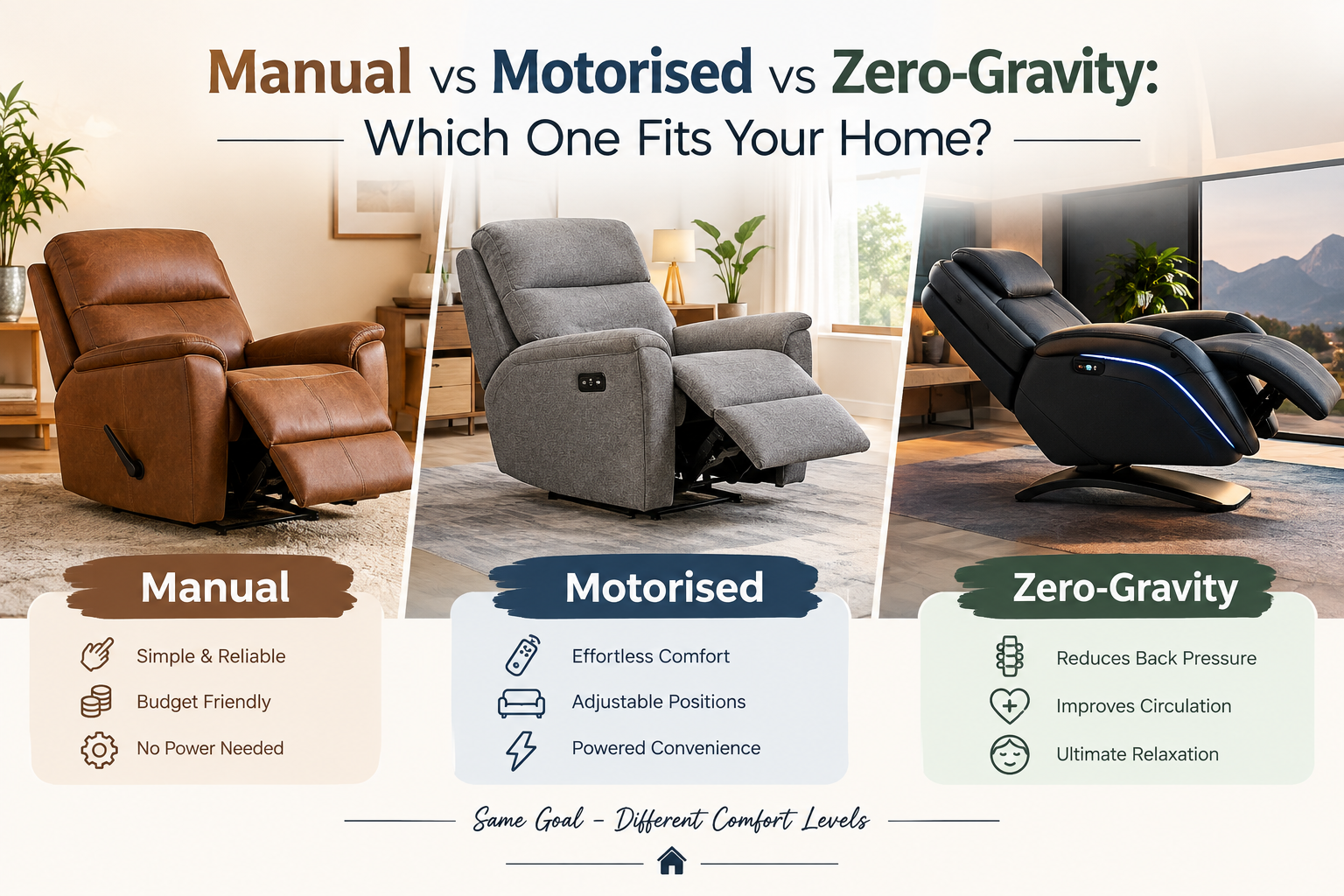
Manual Recliners
The classic pull-lever or push-back mechanism. No motors, no
wiring — just a sturdy frame, a reliable recline action, and a mechanism that's
been refined for decades.
Best suited for:
- Guest
rooms or secondary living spaces used occasionally - Buyers
who prefer fewer mechanical or electronic parts to maintain - Homes
where power outlets near the chair aren't convenient - Anyone
who wants a straightforward, no-fuss recline without extra features
Trade-offs: You lose fine-grained control — it's
typically a two or three-position recline rather than an infinite range, and
there's no headrest or lumbar automation.
Motorised Recliners
Button-controlled backrest and footrest movement, often
paired with powered headrests, USB charging ports and memory positions that
"remember" your preferred angle.
Best suited for:
- The
primary lounge chair used every single evening - People
who value effortless, silent adjustment over manual effort - Anyone
who wants added functionality — charging ports, lighting, storage consoles - Home
theatre and media room seating, where fine control over angle matters
Trade-offs: Requires a nearby power source, slightly
more maintenance over the years, and a marginally higher price point than
manual models.
Zero-Gravity Recliners
Designed to distribute your body weight evenly by tilting
you into a posture similar to what astronauts experience during lift-off —
knees positioned slightly above heart level, spine fully supported.
Best suited for:
- People
managing back strain, poor circulation or swelling in the legs - Anyone
who sits at a desk for long hours and needs a genuine reset in the evening - Buyers
prioritising therapeutic comfort over conventional "TV chair"
styling
Trade-offs: These tend to have a larger footprint
when fully reclined and are generally positioned as a wellness investment
rather than a purely aesthetic one.
A Side-by-Side Snapshot
Feature | Manual | Motorised | Zero-Gravity |
Ease of use | Manual lever/push | One-touch button | One-touch button |
Positions | 2–3 fixed | Multiple/infinite | Infinite, weight-distributing |
Power required | No | Yes | Yes |
Best for | Occasional use | Daily primary seating | Back/circulation relief |
Extra features | Minimal | USB, lighting, memory | Full-body support recline |
What to Consider Before You Buy
Room purpose. A home office recliner needs to support
posture through long work sessions. A living room recliner needs to hold its
own visually next to your sofa. A home theatre recliner needs to prioritise
reclining angle and cup-holder placement over anything else.
Leather quality. A recliner is touched, sat on, and
adjusted daily — far more than a sofa cushion that's simply sat on. Genuine
full-hide Italian leather resists cracking, fading and wear far better than PU
or bonded alternatives under that kind of repeated flexing at the joints and
folds.
Footprint and clearance. Motorised and zero-gravity
recliners typically need 12–20 inches of clearance behind them to recline fully
— always measure your wall distance before finalising placement, especially in
apartments.
Body fit. Seat depth, backrest height and armrest
width should match the primary user's height and build — a recliner sized for
an average frame will feel wrong for someone notably taller or shorter.
Maintenance. Manual recliners need almost no upkeep
beyond regular leather conditioning. Motorised and zero-gravity models benefit
from an occasional check of the motor and wiring, though quality mechanisms are
built to run for years without issue.
Customization Options Worth Asking About
- Recline
angle range and footrest extension length - Headrest
and lumbar adjustment (manual vs powered) - Leather
colour, grain and stitching pattern - Wooden
leg finish vs upholstered base - Console/storage
add-ons for home theatre configurations
Frequently Asked Questions
Can a recliner be customised to my height? Yes — seat
depth, backrest height and footrest length can all be tailored so the recline
supports your body correctly rather than a generic average.